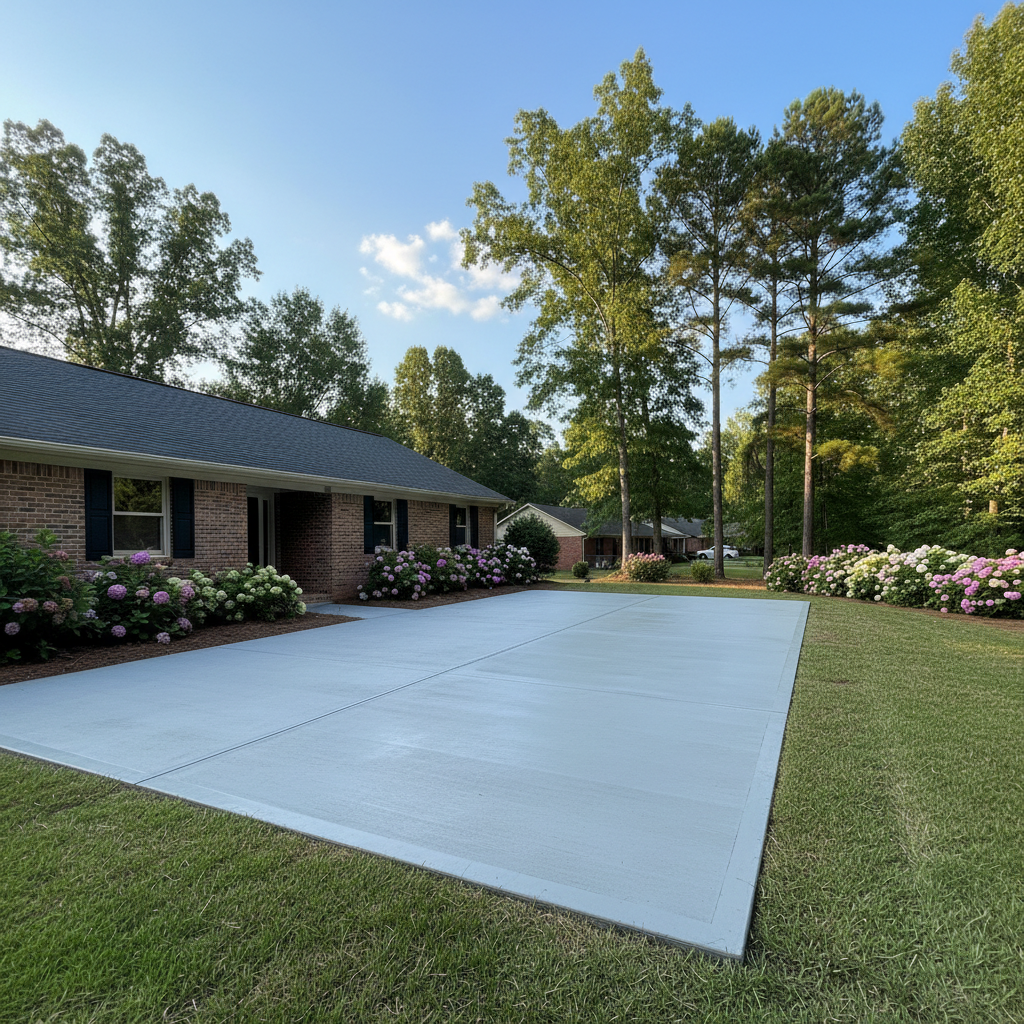
Let's talk about what concrete flatwork actually costs. It's honestly one of the questions I get asked most often, whether folks are planning a new driveway, a shed slab, or maybe just expanding their patio. You want to know what you're getting into financially, and that's totally smart. There's a lot that goes into pricing this stuff, and it's rarely as simple as just a flat rate per square foot.
What Makes Concrete Flatwork Prices Go Up or Down?
A few big things really swing the price one way or the other. If you understand these, you'll make much more sense of the different quotes you get.
- Project Size and Complexity: This one's a no-brainer, right? A bigger area means more material and more labor, plain and simple. But complexity really matters too. A perfectly square, easy-to-access slab is going to be cheaper per square foot than, say, a winding driveway with lots of curves, multiple turns, or some tricky angles. Those custom shapes just take more time and skill to form and pour.
- Site Preparation: This is huge, absolutely huge. If your ground is already pretty level and firm, that's fantastic. But if we've got to do a bunch of excavation, bring in fill dirt, or fix poor drainage, well, that's extra work and extra cost. Here in Madison, especially in some of the older neighborhoods with established trees or areas with a lot of clay, site prep can be a real factor. Sometimes we'll hit old tree roots, or find out the existing ground just isn't stable enough for a good, long-lasting pour.
- Concrete Mix Strength: Not all concrete is created equal, you know? A standard residential driveway might use a 3000 PSI mix, but if you're parking heavy RVs or commercial vehicles, you might need 4000 PSI or even stronger. Stronger concrete costs more per yard. We also think about things like fiber mesh reinforcement or rebar, which definitely add strength and help prevent cracks, but they also add to the material cost.
- Finish Type: A broom finish is standard and the most economical option. It gives you good traction, which is important. But if you want something decorative—like stamped concrete, exposed aggregate, or a colored finish—those are going to bump up the price quite a bit. Stamping, for instance, needs special tools, more labor, and often a higher-quality concrete mix to make sure it holds the pattern well.
- Accessibility: Can our trucks get right up to where we need to pour? If we have to use wheelbarrows to move the concrete a long distance from the truck, or use a pump truck because of obstacles or elevation changes, that's going to add to the labor and equipment costs. It just does.
- Permits and Inspections: For bigger projects, especially driveways that connect to public roads, you'll probably need permits from the city of Madison. These aren't usually a huge cost, but they're part of the overall project and they make sure everything's done to code.
Typical Cost Ranges in Madison, AL
Okay, let's get down to some actual numbers. Remember, these are general ranges for standard broom-finish concrete flatwork. Decorative finishes can easily push these numbers higher, sometimes significantly so.
- Standard Driveway (4 inches thick, broom finish): You're generally looking at anywhere from $6 to $10 per square foot. So, for a typical 500 sq ft driveway, that's $3,000 to $5,000. This range already factors in average site prep. If your site needs a lot of digging or fill, it could be more, of course.
- Patio (4 inches thick, broom finish): Similar to driveways, you can expect $6 to $10 per square foot. A 200 sq ft patio might run you $1,200 to $2,000. Again, decorative finishes will increase this.
- Shed Slab (4 inches thick, broom finish): These are usually on the lower end of the range, around $5 to $8 per square foot, especially for smaller, simpler slabs with good access. A 10x12 (120 sq ft) shed slab could be $600 to $960.
- Walkways (4 inches thick, broom finish): These often fall into the $6 to $9 per square foot range. They can sometimes be a bit more per square foot than a large, open slab because of the extra work involved in forming and finishing narrower sections.
Remember, these are just estimates. The best way to get an accurate price is to get a detailed quote for your specific project.
What Should a Good Quote Include?
When Prime Concrete Co gives you a quote, or when you're comparing bids from other contractors, here's what you should expect to see clearly itemized:
- Material Costs: This covers the concrete itself (including its PSI strength), rebar or mesh, and any gravel base material.
- Labor Costs: The crew's time for everything, from getting the site ready to pouring and finishing.
- Site Preparation: Details on excavation, grading, compacting, and base material installation.
- Forming: The cost of setting up and then removing the forms that shape your concrete.
- Pouring and Finishing: The actual concrete placement and getting that desired finish.
- Expansion Joints and Control Joints: These are crucial for managing cracking, and no good contractor ever skips them.
- Cleanup and Debris Removal: What happens to all the old dirt or broken concrete? Make sure it's hauled away.
- Permit Fees: If they apply to your job, these should be listed.
- Warranty Information: A reputable contractor will stand behind their work, won't they?
A good quote won't just be a single number. It'll break things down so you know exactly what you're paying for.
How to Avoid Overpaying for Concrete Flatwork
Nobody wants to feel like they got ripped off. Here's how you can protect your wallet and still get quality work:
- Get Multiple Quotes: This is probably the most important step you can take. Don't just go with the first guy you call. Get at least three detailed bids. This helps you understand the market rate and spot any outliers—either too high or suspiciously low.
- Compare Apples to Apples: When you get those quotes, make sure they're for the exact same scope of work. Does one quote include rebar and another doesn't? Is one contractor planning more extensive site prep that's actually necessary? Ask questions until you're clear on everything.
- Ask for References and Check Reviews: A low price isn't a good deal if the work is shoddy. Ask for references from past clients and check online reviews. You want to see consistent quality and happy customers.
- Understand the Contract: Before you sign anything, read the contract thoroughly. Make sure all the details we just talked about are in there: scope of work, materials, timeline, payment schedule, and warranty.
- Beware of Extremely Low Bids: If one quote is significantly lower than all the others, that's a red flag. It might mean they're cutting corners on materials, skipping necessary prep work, or aren't properly insured. You really don't want to pay twice to fix a bad job.
- Don't Rush the Decision: Take your time. A good contractor won't pressure you into signing on the spot, believe me.
Doing your homework upfront really pays off, you know? You'll get a fair price for quality concrete work that lasts. If you're in the Madison area and need a quote, give Prime Concrete Co a call. We're always happy to talk through your project.